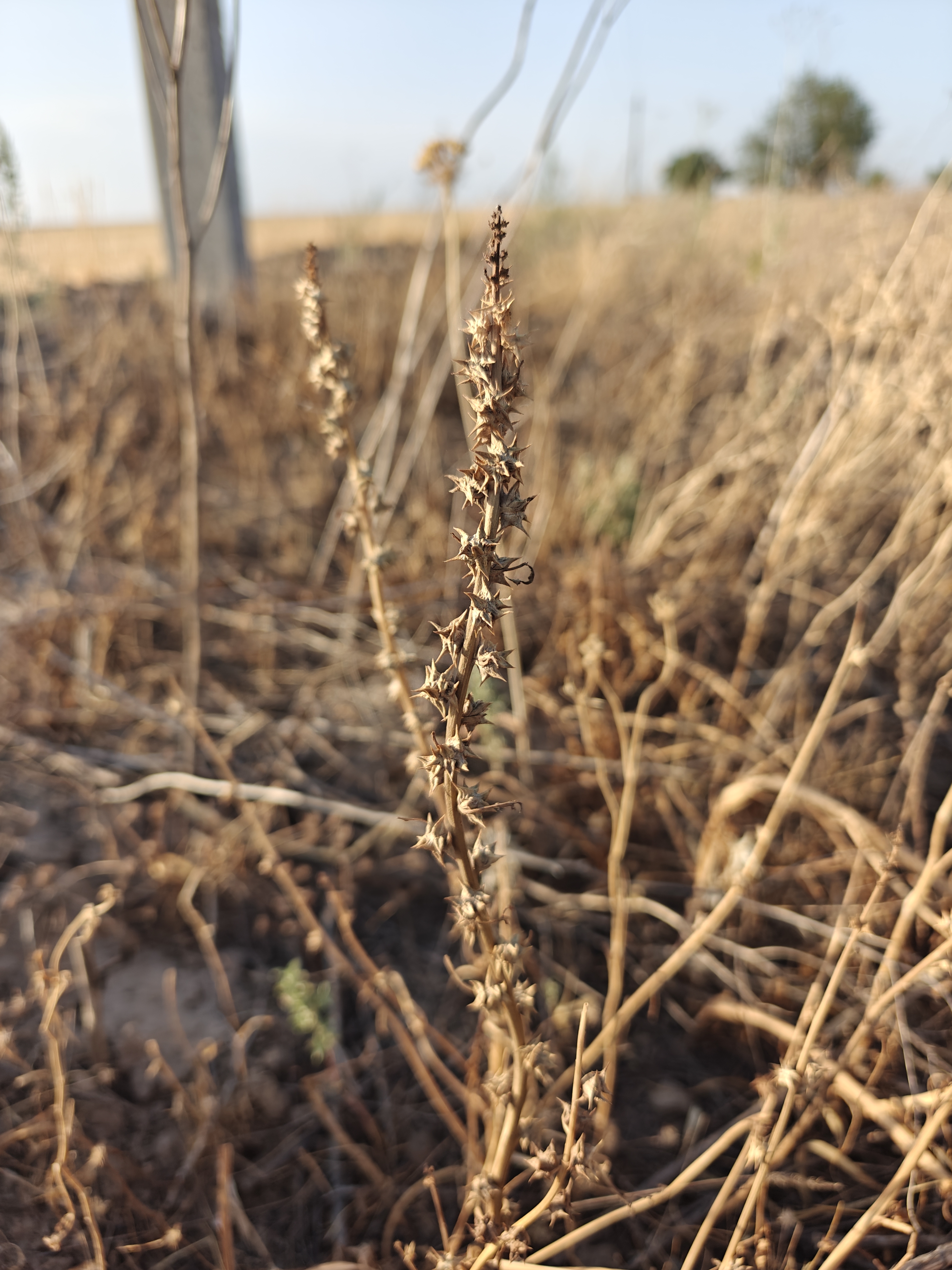
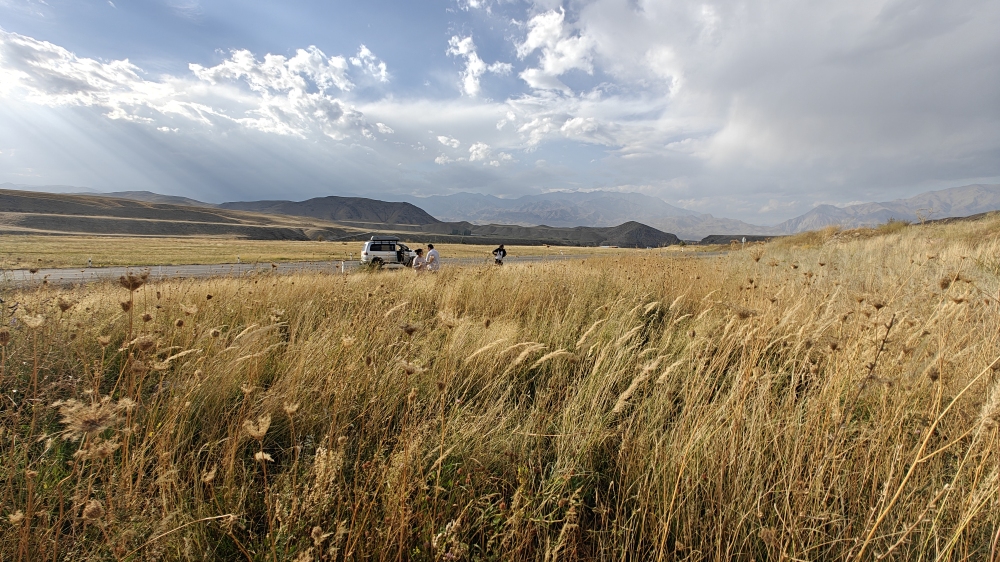
In June 2025, August 2025 and August–September 2026, three collecting expeditions for crop wild relatives (CWR) and cultivated vegetable material were conducted in Kyrgyzstan, spanning 7, 5 and 8 days respectively. The expeditions were funded by the Centre for Genetic Resources, the Netherlands (CGN) and carried out together with the Kyrgyz Genebank. The Kyrgyz Genebank was represented by Aizhan Murzakanova and Diana Turgunbaev in 2025, and by Aizhan Murzakanova and Aitegin Soorbekova in 2026. The team was completed by a botanical expert of the National Academy of Sciences of the Kyrgyz Republic, who also acted as driver: Adilet Usupbaev in 2025 and Nuuraly Burkanov in 2026. Approval for the collaborative activities, including the exchange of the collected materials with the SMTA of the ITPGRFA, was obtained from the relevant Kyrgyz authorities.
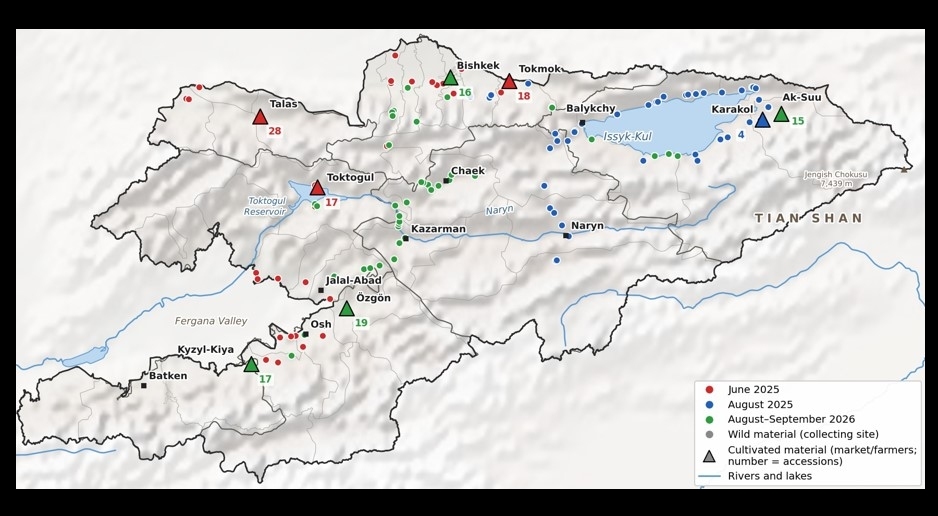
The three missions were planned to cover complementary parts of the country and different moments in the season, so that both early-ripening species (such as wild spinach and the weedy crucifers of cereal fields) and late-ripening species (such as wild lettuce, wild carrot and wild onions) could be sampled with mature seed. Together the expeditions covered an area of roughly 590 × 310 km, with collecting sites between 490 m and 2,560 m altitude (Figure 1).
June 2025 (24–30 June) started in the Chuy valley west and east of Bishkek (Sokuluk, Jayyl, Alamudun, Ysyk-Ata and Chuy districts) and continued south over the mountains via the Suusamyr valley to Toktogul. From there the team descended into the Fergana valley, collecting in the Nooken, Bazar-Korgon and Suzak districts of Jalal-Abad and in the Kara-Suu, Nookat and Aravan districts of Osh region (up to 1,468 m near Bel), before returning north through the Talas valley. Many of the crucifers and wild spinach were found in and along the edges of ripening cereal fields; other habitats included roadsides, road embankments and grassy graveyards. Cultivated material (seeds of vegetables and herbs) was purchased at the markets of Tokmok and Toktogul and at an agricultural shop in Talas.
August 2025 (26–30 August) focused on the Issyk-Kul basin and the Naryn region. After a few stops in the eastern Chuy valley and near Kemin, the team made a full circuit of Lake Issyk-Kul: along the northern shore via Cholpon-Ata, Grigoryevka, Semenovka and Ananyevo to the Tüp and Ak-Suu districts at the eastern end of the lake, and back along the southern shore through Jeti-Ögüz, Tamga, Barskoon and Tong to Balykchy. The mission then continued south via Kochkor and Sary-Bulak (2,560 m, the highest site of the three missions) to Naryn and the At-Bashy district. Some cultivated material was purchased at the market of Karakol.
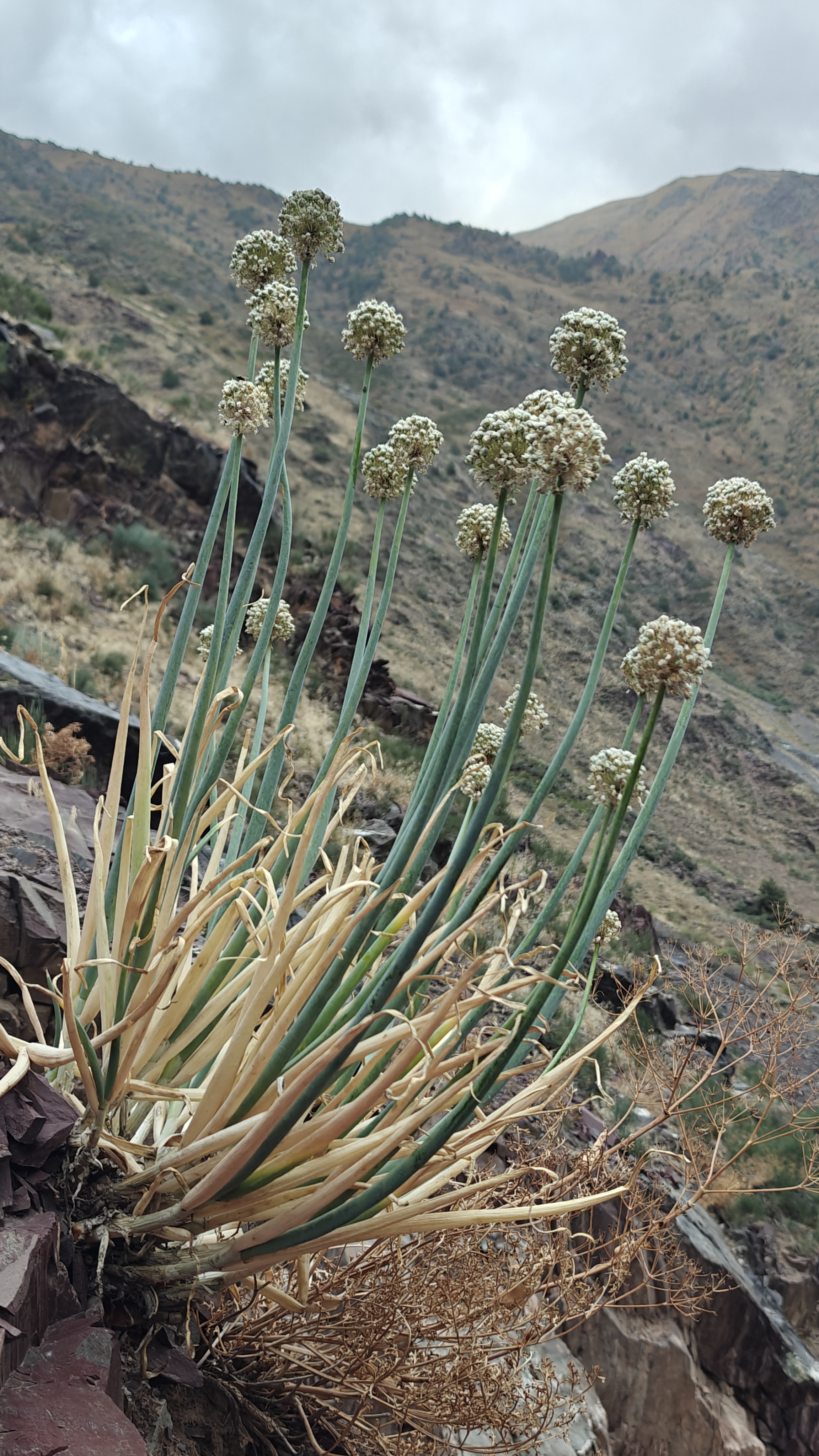
August–September 2026 (31 August – 7 September) followed a new transect through the centre of the country. From the Chuy valley the route led into the gorge south of Sosnovka and the Suusamyr valley (up to 2,251 m), to Toktogul, Jalal-Abad and Osh. From Jalal-Abad the team crossed the mountains eastward on the road to Kazarman, then followed the valleys north through the Toguz-Toro, Toktogul and Jumgal districts towards Chaek. The mission ended along the southern shore of Lake Issyk-Kul in the Tong district and returned to Bishkek via Kemin. The 2026 route yielded many populations of wild onion on rocky mountain slopes, and wild asparagus in thickets along the lake shore. In addition, cultivated material was purchased at the Osh bazaar in Bishkek, and farmers from Ak-Suu (Issyk-Kul region), Kyzyl-Kiya (Batken region) and Özgön (Osh region) sent seeds of their vegetables to the Kyrgyz Genebank in Bishkek, which were included in the collection. Passport data were recorded for every accession, together with GPS coordinates, altitude, population size and the number of plants sampled. Pictures were also taken of the plants in their natural environment.
The three missions collected 311 accessions (177 wild and 134 cultivated) of at least 43 taxa from 28 genera (Table 1). Crop wild relatives of lettuce (Lactuca serriola, L. saligna and L. tatarica, 68 accessions), onion (Allium, 28 accessions), carrot (Daucus carota, 15), chicory (Cichorium intybus, 21) and cabbage and other crucifers (Brassica, Eruca, Sinapis, Raphanus, Isatis, 31) made up most of the wild material. Some of the accessions, especially of Allium, Asparagus and Brassica, need further taxonomic identification.
The three missions collected 311 accessions (177 wild and 134 cultivated) of at least 43 taxa from 28 genera (Table 1). Crop wild relatives of lettuce (Lactuca serriola, L. saligna and L. tatarica, 68 accessions), onion (Allium, 28 accessions), carrot (Daucus carota, 15), chicory (Cichorium intybus, 21) and cabbage and other crucifers (Brassica, Eruca, Sinapis, Raphanus, Isatis, 31) made up most of the wild material. Some of the accessions, especially of Allium, Asparagus and Brassica, need further taxonomic identification.
The cultivated material comprises 29 species, mainly vegetables and herbs typical of Kyrgyz home gardens and markets: radish and daikon (Raphanus sativus, 15 accessions), pumpkins and squash (Cucurbita, 11), cucumber (Cucumis sativus, 8), carrot, pepper, dill, tomato, beans and several herbs such as basil, coriander, fenugreek, sorrel and Chinese chives (Allium tuberosum).
Table 1. Accessions collected in Kyrgyzstan in 2025 and 2026
| Botanical name | Jun 2025 | Aug 2025 | 2026 | Total | Type of material |
|---|---|---|---|---|---|
| Amaranthaceae | |||||
| Beta vulgaris | 4 | – | 3 | 7 | cultivated |
| Blitum virgatum | – | – | 1 | 1 | wild |
| Spinacia oleracea | 1 | – | 1 | 2 | cultivated |
| Spinacia turkestanica | 7 | – | – | 7 | wild |
| Amaryllidaceae | |||||
| Allium cepa | 2 | – | 4 | 6 | cultivated |
| Allium fistulosum | 1 | – | – | 1 | cultivated |
| Allium galanthum | – | 1 | 16 | 17 | wild |
| Allium oschaninii | – | – | 1 | 1 | wild |
| Allium sp. | 1 | – | – | 1 | cultivated |
| Allium sp. | 5 | – | 5 | 10 | wild |
| Allium tuberosum | 3 | – | – | 3 | cultivated |
| Apiaceae | |||||
| Anethum graveolens | 3 | 1 | 5 | 9 | cultivated |
| Apium graveolens | 3 | – | 2 | 5 | cultivated |
| Coriandrum sativum | 3 | – | 3 | 6 | cultivated |
| Daucus carota | 3 | – | 6 | 9 | cultivated |
| Daucus carota | – | 12 | 3 | 15 | wild |
| Pastinaca sativa | – | 1 | – | 1 | wild |
| Petroselinum crispum | 2 | – | 3 | 5 | cultivated |
| Asparagaceae | |||||
| Asparagus officinalis | – | 1 | – | 1 | wild |
| Asparagus sp. | – | – | 4 | 4 | wild |
| Asteraceae | |||||
| Cichorium intybus | 7 | 10 | 4 | 21 | wild |
| Lactuca saligna | – | – | 4 | 4 | wild |
| Lactuca sativa | 4 | – | 1 | 5 | cultivated |
| Lactuca serriola | 15 | 37 | 7 | 59 | wild |
| Lactuca tatarica | 1 | 4 | – | 5 | wild |
| Brassicaceae | |||||
| Brassica oleracea | – | – | 3 | 3 | cultivated |
| Brassica sp. | 1 | – | – | 1 | cultivated |
| Brassica sp. | 8 | 10 | 1 | 19 | wild |
| Eruca sp. | 6 | 2 | – | 8 | wild |
| Isatis tinctoria | 1 | – | – | 1 | cultivated |
| Isatis tinctoria | 1 | – | – | 1 | wild |
| Raphanus raphanistrum | 1 | 1 | – | 2 | wild |
| Raphanus sativus | 7 | 1 | 7 | 15 | cultivated |
| Sinapis sp. | 1 | – | – | 1 | wild |
| Cucurbitaceae | |||||
| Cucumis melo | 1 | – | 2 | 3 | cultivated |
| Cucumis sativus | 7 | – | 1 | 8 | cultivated |
| Cucurbita pepo | 2 | 1 | – | 3 | cultivated |
| Cucurbita sp. | – | – | 8 | 8 | cultivated |
| Fabaceae | |||||
| Phaseolus vulgaris | – | 1 | 4 | 5 | cultivated |
| Pisum sativum | – | – | 1 | 1 | cultivated |
| Trigonella foenum-graecum | 1 | – | – | 1 | cultivated |
| Vigna sp. | 2 | – | – | 2 | cultivated |
| Lamiaceae | |||||
| Ocimum basilicum | 4 | – | – | 4 | cultivated |
| Polygonaceae | |||||
| Rumex acetosa | 2 | – | – | 2 | cultivated |
| Solanaceae | |||||
| Capsicum annuum | 2 | – | 6 | 8 | cultivated |
| Solanum lycopersicum | 1 | – | 5 | 6 | cultivated |
| Solanum melongena | 2 | – | 2 | 4 | cultivated |
| Total | 115 | 83 | 113 | 311 | |
After collecting, the seeds of each accession were split, and half of each sample was left with the Kyrgyz Genebank. In accordance with the agreement between CGN and the Kyrgyz Genebank, CGN is responsible for the multiplication and maintenance of both the crop wild relatives and the cultivated material collected during the missions. For accessions with insufficient seed, CGN will multiply the material and return a sample to the Kyrgyz Genebank. If multiplication is successful, the accessions will be made available to potential users.